
Tracing Former Owners of a Wood County Property
Ownership in Wood County crosses several record formats. The Clerk's online index is a starting point for recorded instruments. It is not a complete title abstract for every year. Deed books reach back to 1799 on the shelf. Some earlier-looking references still call for in-person help or archival context. Each historical finding aid below has its own coverage. None indexes every parcel the same way, so plan on using several together.
| Source | Years It Covers | Where Held | What It Shows |
|---|---|---|---|
| County Clerk deed books | 1799 to present holdings | Record Room, Room 103 | Recorded conveyances and legal descriptions |
| FamilySearch deed-book films | About 1802–1900, 16 reels | FamilySearch catalog access | Images of selected historic deed books |
| Historical deed index | Catalog described as 1798–1969 | Library and archival finding aids | Names and book references, subject to index coverage |
| WVU A&M 0458 collection | 1785–1935 collection span | WVU archives | Regional papers and historic materials, not a deed index |
Begin with the current deed. Work backward through the Clerk's recorded chain one conveyance at a time. When the index stops short of the year you need, note the last deed book and page. Then pull that volume or film. Archival date ranges describe a collection's scope. They do not promise an unbroken chain for every parcel. A plat can clarify subdivision lots. Yet it never replaces the deed that actually conveyed the interest.
Using the Wood County Historical Deed Index
The historical deed index described in the catalog covers Wood County material from 1798 through 1969. Read that range as a finding-aid description. No online name search covers everything. Indexes sort by grantor and grantee. Older entries may show initials, spelling variants, or a legal description instead of a modern street address. Try more than one spelling of a name. Follow the cited book and page into the deed itself.
The FamilySearch catalog identifies the historic Wood County deed collection and its year range.
The Clerk's Record Room sits at 1 Court Square, Room 103, in Parkersburg. Hours are weekdays, 8:30 a.m. to 4:30 p.m. Staff can point you to the right book or index. They do not perform title searches. When a citation is unclear, ask about the exact volume. Also ask about the copy process.
Following a Wood County Chain Through Estates
A chain does not always run from sale deed to sale deed. Owners die. Property passes through an estate, into a trust, or as a fractional interest. Search the grantee named in the last deed. Look for estate or fiduciary instruments first. A fiduciary may sign as executor, administrator, trustee, or another stated role, so read that capacity beside the land description.
Historic names come in many spellings. County and date context separates similar people. A deed covering only part of a tract can leave the remaining interest with the prior owner. Record every detail. Note the book and page, parties, date, and exact description, so split or reunited parcels do not collapse into one false sequence.
Matching Old Wood County Deeds to Today’s Parcel
Older deeds describe land by metes and bounds. They may cite adjoining owners, a district, or a tract name. This stands in for a parcel number or street address. Later deeds often refer back to an earlier conveyance. A subdivision plat can supply lot and block references. These tie historic wording to a modern neighborhood. Search the legal description first. Never assume an address variation means the property is unrelated.
The Clerk catalog lists plat record types. Examples include PLAT, LITTLE PLAT, and BIG PLAT BOOK. A plat records a plan or division of land. It helps interpret a lot layout. But it does not prove ownership of every lot or fix a surveyed boundary on the ground. Pair a plat reference with the deed and, when necessary, current mapping information.
Wood County’s Preserved Deed and Archive Records
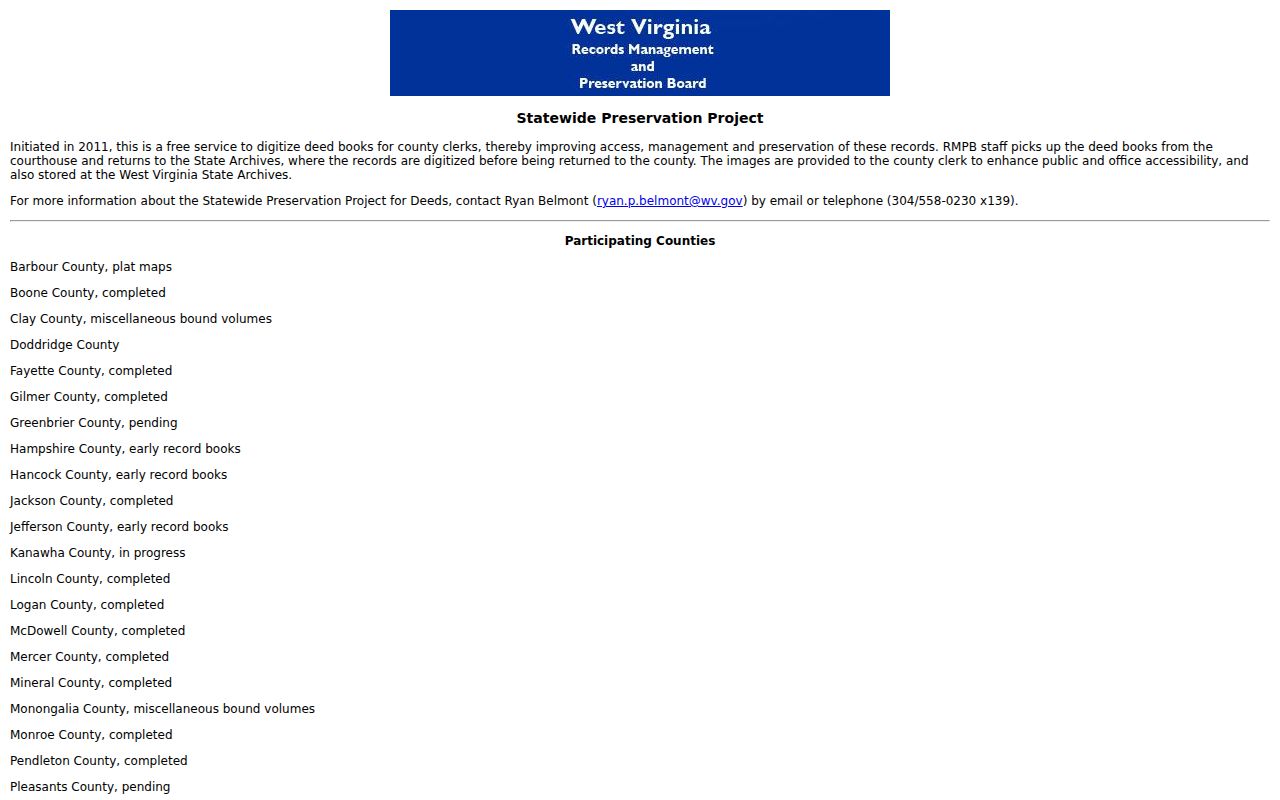
Wood County took part in the West Virginia deed preservation project. The project reports the county's work as completed. Preservation improves access to historic records. It does not mean every original instrument is indexed by modern parcel number. It also does not mean every instrument is freely searchable online. Use the project to reach preserved documents. Keep a citation to the original deed book or instrument.
The State deed preservation project page provides a county-specific archival access point.
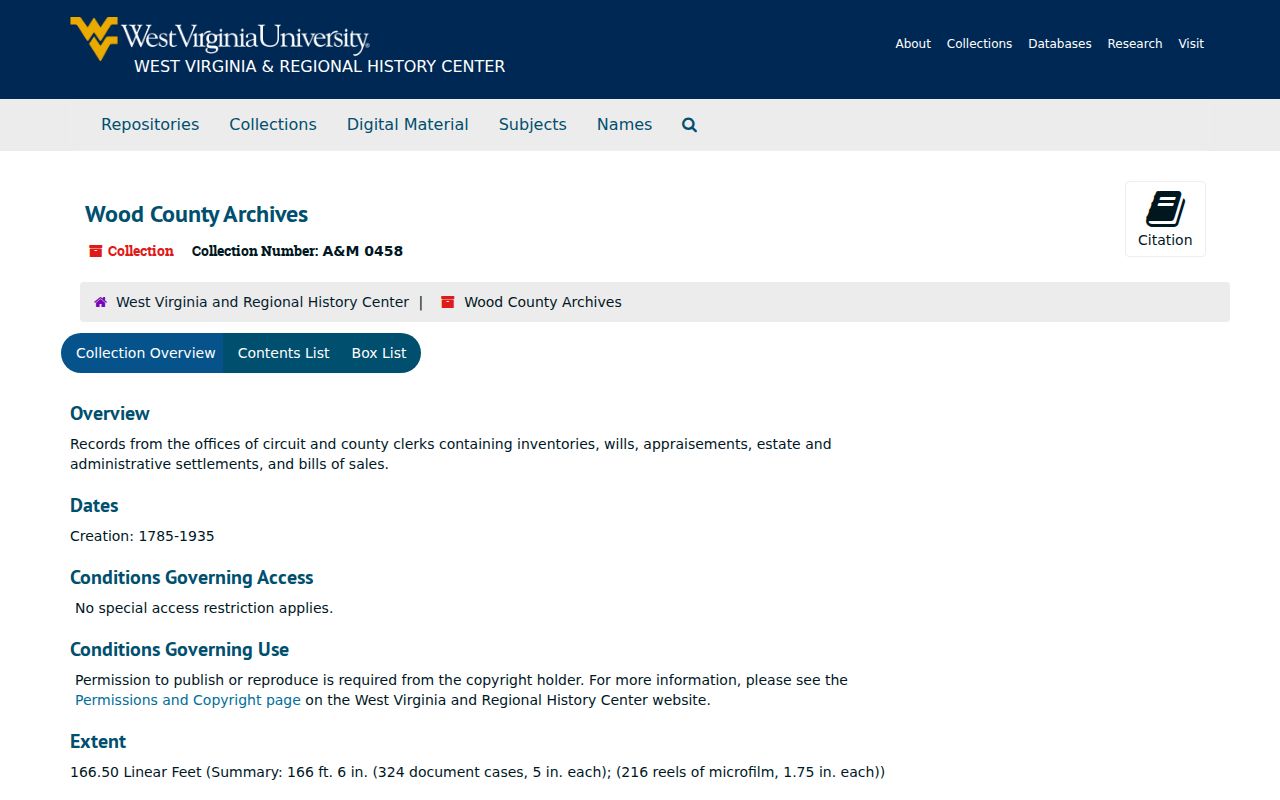
WVU’s A&M 0458 archive page describes a Wood County related collection covering 1785–1935.
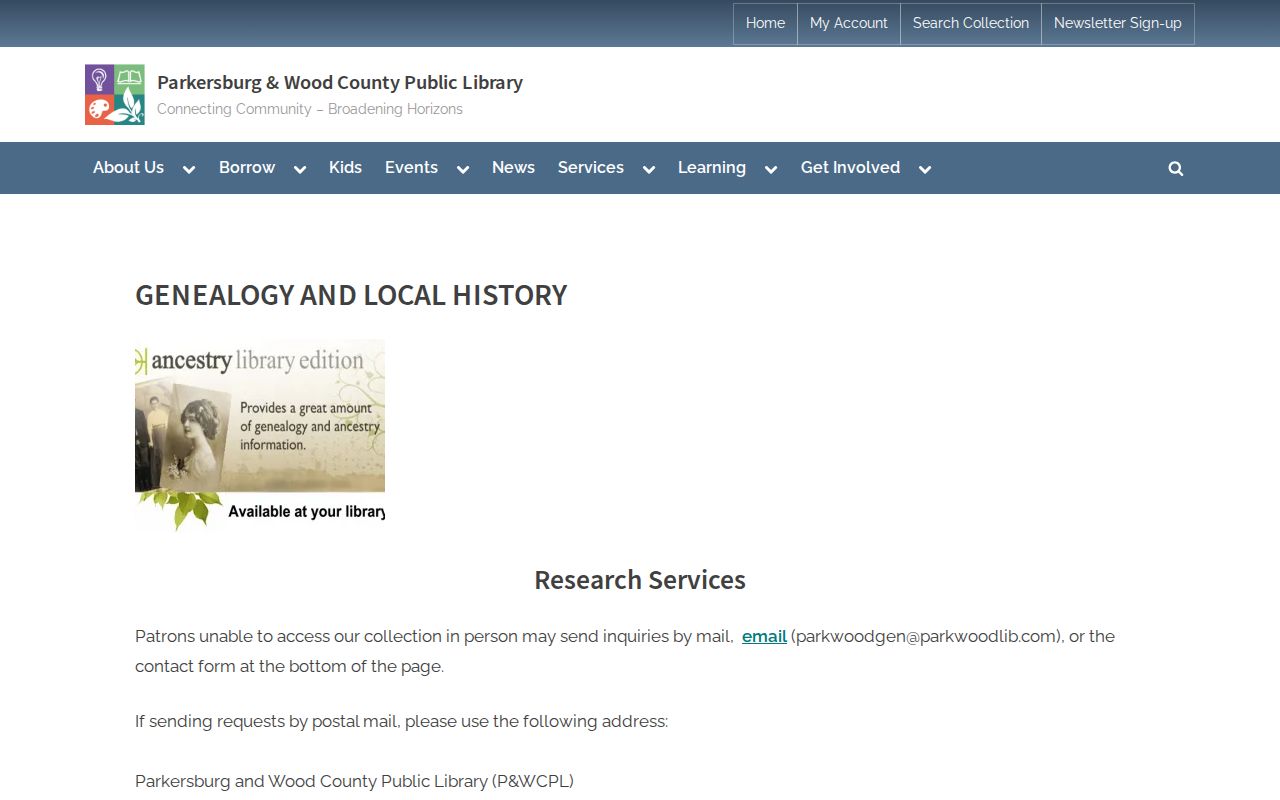
Parkwood Library's genealogy collection serves Parkersburg and Wood County. Its microfilm and local-history research requests, limited to five at a time, cost a $2 minimum plus $0.10 per page. Newspaper searches need a month and year.
A library lead is only a lead. It can point you toward a name or a date, but the actual transfer of ownership must be confirmed in a deed or another official instrument. Start with one focused request. Give the library the family or property name, the locality, and an approximate date range. Newspaper lookups work best with a month and year. Because staff limit how many items they will handle, split a long list into a few priority questions and send those first. Microfilm or obituary work may surface a former owner or a move date. That clue then guides a search of the County Clerk index, the historical deed index, or the WVU collection. Each small answer narrows the next Wood County property records search.
What a Wood County Former Owner Search Cannot Prove
A list of past grantees is not a title opinion. It may leave out liens, releases, easements, judgments, probate events, or interests conveyed outside a simple sale. That list can miss other things too. Records filed under a different name or description can slip past it. The present location of a boundary also remains unsettled. The chain may matter for a sale, inheritance, boundary dispute, or legal claim. In that case, have a qualified title professional or attorney review the original instruments. The County Clerk's Record Room preserves recorded documents. It provides access to them, but it does not run title searches. Copies cost $1.50 for the first two pages, then $1 per additional page. Before ordering copies or making the trip, confirm the current copy method and any online image charges with the Clerk.
Walking the Wood County Deed Chain Backward
Begin with a document that pins down the exact parcel. A deed, plat, or tax bill with the parcel number gives you a fixed starting point. From there, repeat the same grantor-to-grantee lookup. Treat each earlier owner of record as the next search subject. Log every instrument reference in a table or notebook. Do this as you move back through the Wood County deed records. A name by itself proves nothing about continuity of ownership.
- Locate the latest deed into the present owner and verify its land description against the parcel you mean.
- Record the grantor, grantee, date, deed book and page, and any cited earlier instrument.
- Search the prior owner as grantee, then identify that owner’s later deed as grantor to continue backward.
- When a searchable index stops, carry the last citation into the corresponding deed book, historical index, or film.
- Grantor / grantee
- The party conveying an interest and the party receiving it, as named in an instrument.
- Chain of title
- The connected sequence of recorded transfers and other instruments affecting ownership.
- Legal description
- The written land identification in a deed, often more useful than a modern street address for older records.
How Far Back Wood County Ownership Records Go
Wood County was organized in 1798. The Clerk's deed books are described as reaching back to 1799. This makes them one of the older record sets in the state. The county's preservation project and the surviving historical indexes open other routes. They lead into early ownership records. No single destructive courthouse fire explains a broad gap in the deed record. Instead, evaluate any gaps document by document rather than assuming a countywide loss. One caution: colonial land grants and later recorded deeds are different source types. They may call for separate searches in the Wood County property records.
House-history use. Former-owner research is most useful for documenting a home’s history, understanding a deed chain, or preparing property diligence. Respect the privacy of living people and keep research tied to the land and its recorded documents.